RV industry causing deforestation in Borneo, Indonesia
The Supply Chain I Never Thought About
I did not think about the forest when I bought my RV.
I thought about floor plans.
Tank capacity.
Tow weight.
Wide open spaces.
Connecting with nature.
I did not think about where the walls came from.
I posted about the new RV purchase, then a dear Indonesian friend sent me a video about how Indonesian forests are suffering because of the direct line to the USA's RV industry.
And my stomach dropped.
Not because my specific RV was implicated.
But because I had never even asked the question.
The Forest Behind the Walls
A New York Times report by Sui-Lee Wee detailed how tropical hardwoods like lauan and meranti, used in some RV construction, have been linked to rainforest clearing in Indonesia.
Concessions spanning hundreds of thousands of acres.
Villages say they were not properly notified.
Sacred forests flattened.
Orangutan habitat erased.
Organizations like Mighty Earth and Endangered Species International have pushed a simple message:
You don’t need rainforests to build RVs.
That line hit me hard.
Because I love the outdoors. I built a life around chasing wild spaces. And yet I had not considered whether my home on wheels might be quietly tied to the loss of someone else’s forest.
The Relief and the Reckoning
After reading everything I could, I went straight to my manufacturer’s specifications.
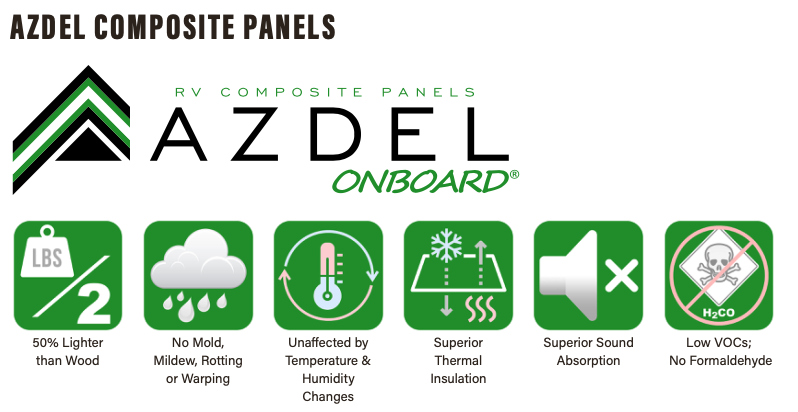
I own a KZ travel trailer. And KZ uses Azdel composite panels instead of lauan plywood.
Azdel is a composite material that does not rely on tropical rainforest hardwood. It is lighter, more durable, and not sourced from Indonesian forests.
I felt relief.
Not pride. Relief.
My decision to prioritize quality construction, durability, and moisture resistance unintentionally steered me away from materials linked to deforestation.
But here is the uncomfortable truth:
That was luck.
I did not choose Azdel because I researched Indonesian logging permits.
I chose it because it was marketed as better quality.
The outcome aligned with my values.
The process did not.
And that matters.
Why This Feels Personal
I spent at least two years living and researching in Indonesia, focusing on marine protected areas and how conservation policy shapes local communities.
I studied the tension between livelihoods and environmental protection. I listened to fishermen navigating new restrictions. I learned how decentralized governance can complicate enforcement. Policies may exist on paper, but permits still get issued. Forests still get cleared.
So when I read about deforestation tied to global supply chains, it was not abstract.
It was a place I had walked.
A language I have spoken.
Communities I have sat with.
The idea that American outdoor recreation could be connected to forest loss there felt like a thread running straight through my chest.
Loving the Outdoors Should Not Require Tradeoffs
We should not have to choose between exploring nature and protecting it.
Consumers should not have to perform forensic investigations into plywood sourcing just to enjoy camping.
Manufacturers carry responsibility here.
If alternatives like composite panels exist, they should be the standard, not the premium upgrade. Transparency should not be optional. Ethical sourcing should not be a marketing afterthought.
The love of wild spaces cannot stop at the campground entrance.
What We Can Do
This is not about panic. It is about awareness and accountability.
Here are tangible steps:
Ask manufacturers directly what materials they use. Specifically ask about lauan or meranti plywood.
Support brands that use alternatives to tropical hardwood, such as composite panels.
Share reporting from organizations like Earthsight and Mighty Earth so more consumers understand the supply chain.
Email companies and ask for sourcing transparency.
Remember that supply chains are global. Our purchases ripple. Just ask Target to allow ICE in their stores and roll back on DEI programs. The stock declined by more than 40% last year.
https://www.cnn.com/2025/11/19/business/target-stock-economy
My RV does not appear to contain any Indonesian rainforest wood. I am grateful for that.
But the bigger realization is this:
I never asked.
And if we, the people who claim to love the outdoors most, do not ask hard questions about how our gear is built, who will?
The forest that suffers to build the RV walls matters just as much as the forest outside the window.
Further Reading & Research: Following the Supply Chain
If you want to sit with this longer, to trace the threads beyond this post, these are the investigations and organizations that shaped my understanding. Each one pulled back a different layer of the same story.
---
Earthsight — How America’s RV Industry Is Destroying Indonesia’s Rainforests
This is the piece that started it all for me.
> “Earthsight and Indonesia-based Auriga Nusantara shared government documents and shipping records showing how deforested wood travels from Indonesian rainforests to American R.V. makers.”
What stayed with me here is the paper trail. This is not abstract. It is documented, traced, and mapped across oceans.
---
The New York Times (via RV Business summary) — Rainforests Are Being Cleared to Build Your RV
Reported by Sui-Lee Wee, this piece connects demand directly to environmental and human impact.
> “In the last five years alone, tens of thousands of acres of the island’s forests have been chopped down for lauan… unleashing dense stores of carbon, upending the lives of Indigenous people and endangering the habitats of orangutans and other animals.”
> “Maria Adoh had planted rubber trees over a decade… ‘It was all flattened,’ she said, in tears.”
This is where the story shifts from supply chain to lived reality. Numbers turn into names.
---
France 24 — US Demand for RVs Fuels Deforestation on Indonesia’s Borneo
This article highlights the scale and governance gaps behind the issue.
> “Mayawana… had a concession of nearly 350,000 acres… residents said [they were] not notified.”
> “It razed nearly 100,000 acres… Satellite imagery reveals the speed and scale of the deforestation.”
> “For generations, the hamlet’s ethos has been to conserve this hilly forest… ‘Animals should not be disturbed, large trees should not be cut down.’”
> “Although the government ordered Mayawana to stop logging… the company’s permits had not been revoked.”
This is the tension I remember from Indonesia: policy, permission, and reality rarely move at the same speed.
---
Mighty Earth — Campaign on RV Supply Chains
🔗 [https://mightyearth.org/article/rv/](https://mightyearth.org/article/rv/)
A single line that feels like a compass:
> “YOU DON’T NEED RAINFORESTS TO BUILD RVS.”
Endangered Species International — The RV Industry’s Hidden Secret: Deforestation in Borneo
This piece reinforces the ecological stakes and pushes for alternatives within the industry.
What I took from this: solutions already exist. The gap is not innovation. It is adoption.
---
Think of this as your dive log before entering deeper water.
These sources are not just citations. They are vantage points:
Investigative reporting tracing supply chains
On-the-ground impacts on communities
Environmental consequences at the ecosystem scale
Advocacy pushing for industry change
If this post planted a question in your mind, these will help you follow it all the way down.
Because once you start looking at how things are made, it becomes impossible to see them the same way again.